
Solar Panel Maintenance In Manchester
Is your solar array still producing what it did in year one?
Inspection, testing, cleaning and repairs for commercial PV and battery systems, whoever installed them
Solar panel maintenance in Manchester is mostly about finding out what nobody has noticed. A commercial array can lose a whole string, or an inverter can trip and stay off, and the building carries on as normal because the grid quietly fills the gap. The first sign is often an electricity bill that crept up months ago. We look after commercial PV and battery systems across Greater Manchester, including plenty fitted by installers who have since closed or stopped answering the phone. A visit covers what's measurable: generation against what the array should be making for the month, inverter fault logs, insulation and string tests, thermal imaging of panels and connections, DC isolators and cable condition. Then we fix what we find, or tell you plainly where a repair isn't worth the money.
Book an inspection or report a fault
We reply within one working day to book a site visit.
What regular maintenance actually pays for
Solar has no moving parts, which is why people assume it needs nothing. The electronics, cabling and connections around the panels are a different story.
01
Lost generation spotted in weeks, not years
An inverter that trips on a Friday can sit idle until someone reads the meter. We compare monthly output against PVGIS figures for your site: at Trafford Park, a south-facing array at 40° should make about 110 kWh per kWp in June and 30 in December. A shortfall against that baseline points straight to the fault.
02
Hot spots found before they spread
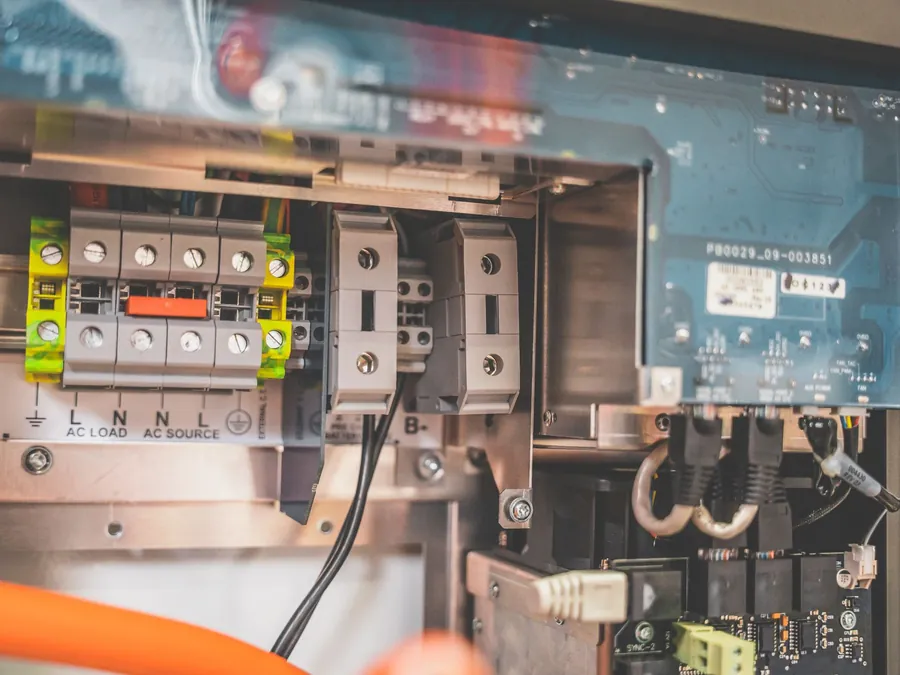
A cracked cell, a failing bypass diode or a loose connector runs hotter than everything around it. A thermal camera shows it on a sunny day in a way nothing else can. Fixing a single connector early is cheap; finding it after it has scorched a cable tray on a roof isn't.
03
Evidence for your insurer
The joint code of practice on PV fire safety, RC62, was written by RISCAuthority, MCS and Solar Energy UK specifically for insurers and the businesses they cover. Inspection records, test results and thermal surveys are the kind of evidence an insurer may ask for after a claim, or at renewal. Check your own policy wording.
04
Degradation separated from faults
Panels do lose output slowly. NREL's long-running review of field data puts the median loss at about 0.5% a year. Anything much worse than that isn't ageing, it's a problem: soiling, shading from new growth or a damaged string. Annual testing tells you which.
05
Inverter replacement you can budget for
Inverters wear out well before panels do. The Energy Saving Trust suggests replacement after about ten to twelve years for home systems, and commercial units vary by model. Tracking error logs and efficiency over time lets you plan a replacement into next year's capital budget rather than finding out when one stops.
06
Safe access, planned once
HSE reports that falls through fragile surfaces, particularly fibre-cement roofs and rooflights, cause 22% of fall-from-height deaths in construction. Many of the sheds carrying older arrays here have exactly those roofs. We plan access, edge protection and walkways for your roof once, then reuse that plan on every visit.
£0
Site survey and a review of your half-hourly data
kWh
Systems sized from your own meter readings
G99
Grid application drawn up and submitted for you
M17
Based on Trafford Wharf Road, Trafford Park
What Manchester weather and buildings do to arrays
South Manchester is drier than its reputation suggests. The Met Office average for Woodford is 868 mm of rain a year, well below the UK figure and far below the wider north-west. It still rains on about 156 days a year, though, and showers don't fully clean low-tilt panels. Grime collects along the bottom edge where water pools, and on industrial estates near the M60, M62 and the Ship Canal, dust from yards and traffic sticks to it.
The buildings themselves bring their own problems. Plenty of older sheds in Trafford Park, Salford and Bolton have fibre-cement roofs, some early commercial arrays went straight onto them, and some of those sheets contain asbestos. Maintenance there means planning access around fragile sheets, not just turning up with a ladder.
Then there's the age of the systems. Many were fitted in the Feed-in Tariff years, often by firms that no longer trade. Owners are left with no drawings, no login to the monitoring portal and no idea who to call when the inverter screen shows a fault code. Taking over those systems is a large part of what we do.
"Most of the inherited systems we're asked to look at have been underperforming for longer than the owner realises, usually because the monitoring login went with the original installer."
What happens on a commercial solar maintenance visit
- 1
Gather the paperwork and the data
We ask for whatever exists: commissioning certificates, single-line diagrams, monitoring access and recent meter readings. If there's nothing, we start by recording the system as found, which becomes the record you were never given.
- 2
Compare output with the expected yield
Using your array size, tilt and orientation, we work out what it should produce month by month and set that against actual readings. The gap tells us how urgent the visit is and where to look first.
- 3
Plan safe roof access
Before anyone goes up, we confirm the roof construction, mark fragile sheets and rooflights, and set up edge protection or walkways as needed. On asbestos-cement roofs, nothing is drilled or walked on without controls in place.
- 4
Visual check and thermal imaging
We walk the array checking for cracked glass, loose clamps, damaged cables and debris, then run a thermal camera across panels, connectors and isolators while the array is under load.
- 5
Electrical testing to BS 7671
Each string is tested for voltage, current and insulation resistance, and inverters and AC protection are checked. Batteries are tested against the current edition of BS 7671, which since Amendment 4 in 2026 includes a chapter on stationary batteries.
- 6
Clean and repair
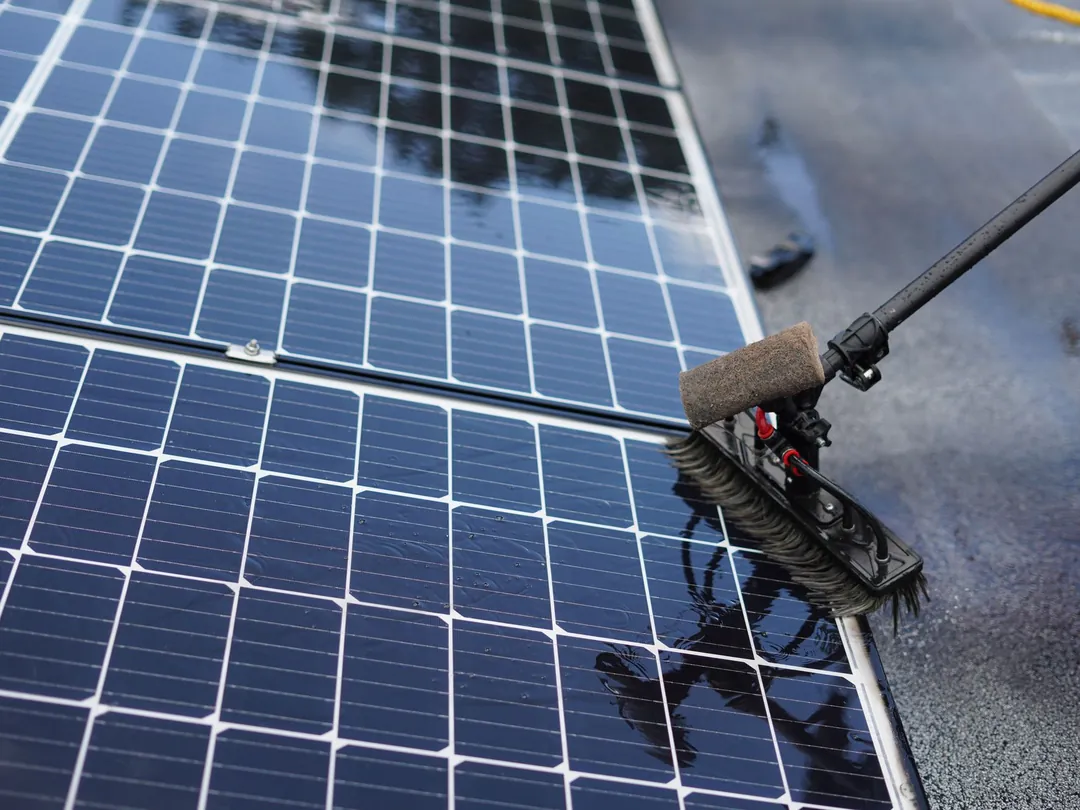
Panels are washed with purified water and soft brushes, never pressure washers or harsh detergents that can damage seals and glass coatings. Small repairs happen on the day; bigger ones, like replacing an inverter or a run of cable, are quoted separately.
- 7
Report and next visit
You get a written report with photos, thermal images, test results and a prioritised list of actions. We set a date for the next visit and, if you want, take over watching the monitoring between visits.
Who answers for your Manchester installation, and for how long
There are two layers of cover on a commercial installation, and it pays to know which is which. The first is the installer's workmanship guarantee. It covers the way the system was put in: the fixings through your roof, the cable runs, the terminations, the protective devices and the commissioning settings. Its length and terms are written into the quotation, so you can read them before you sign rather than discover them afterwards.
The second layer belongs to the manufacturers. Panels normally carry a product warranty and a separate performance warranty, which promises a minimum output after a set number of years. Inverters and batteries have their own terms, often with cycle or throughput limits on storage. These vary by product, so every proposal names the exact models and attaches their warranty documents.
A guarantee is only as good as the install underneath it. That's why the structural check comes before the design is fixed, why every string is tested and recorded to BS 7671, and why the grid connection is commissioned to the settings SP Electricity North West has approved. If something we fitted fails because of how it was fitted, we come back and put it right.
In writing
Workmanship guarantee, set out in your quote
Per model
Manufacturer product and performance warranties
Test results, drawings, warranty certificates and the grid connection agreement are handed over in one pack on the last day.
What to look for in a solar maintenance contractor
They'll take on another installer's system
Some firms only maintain what they fitted. That's no help if your installer has gone. The right contractor will survey an unfamiliar system, work out what's there from labels and testing rather than drawings, and give you a full record afterwards. Ask whether they've worked on your inverter brand before, and whether they can get access to its monitoring portal or will need to install their own logger.
Testing, not just cleaning
A firm that turns up with a water-fed pole and nothing else is a window cleaner with a different label. Proper maintenance includes insulation resistance tests, string measurements, thermal imaging and inverter checks, recorded against previous visits so trends show up. Ask to see a sample report. If it's a single page saying everything looked fine, you're paying for a wash.
They know the fire and access guidance
Commercial roof arrays carry fire risk that insurers take seriously, which is why RC62 exists. The contractor should know where DC isolators are, how cables are routed across combustible roof build-ups and what the code recommends. They should also follow HSE guidance on fragile roofs without being prompted. Ask how they'll access your roof before they quote.
No contract, call-out only or planned maintenance
Owners usually fall into one of these three groups. Here's what each one tends to mean in practice for a commercial array.
| Comparison point | No arrangement | Call-out when it fails | Planned O&M |
|---|---|---|---|
| Who spots a fault | Usually the finance team, via the bill | Whoever notices the inverter screen | Monitoring alerts and scheduled tests |
| Likely downtime | Months | Weeks | Days |
| Insurer evidence | None | Repair invoices only | Dated test and thermal records |
| Cleaning | Rain only | When someone remembers | Scheduled to suit the site |
| Inverter end of life | Comes as a surprise | Comes as a surprise, but faster to fix | Planned and budgeted |
| Cost pattern | Nothing until a big bill | Unpredictable | Fixed, known in advance |
Maintaining batteries alongside the panels
A battery adds more to check: cell temperatures, state of charge behaviour, ventilation, the inverter's charge and discharge logs, and whether it's still doing the job it was sold for. A unit set up to shave evening peaks that drifts into charging from the grid at the wrong time can quietly cost money.
BS 7671 gained a dedicated chapter on stationary secondary batteries in Amendment 4, published in April 2026. Older installations aren't automatically non-compliant, but an inspection now has a clearer standard to test against.
More on commercial battery storage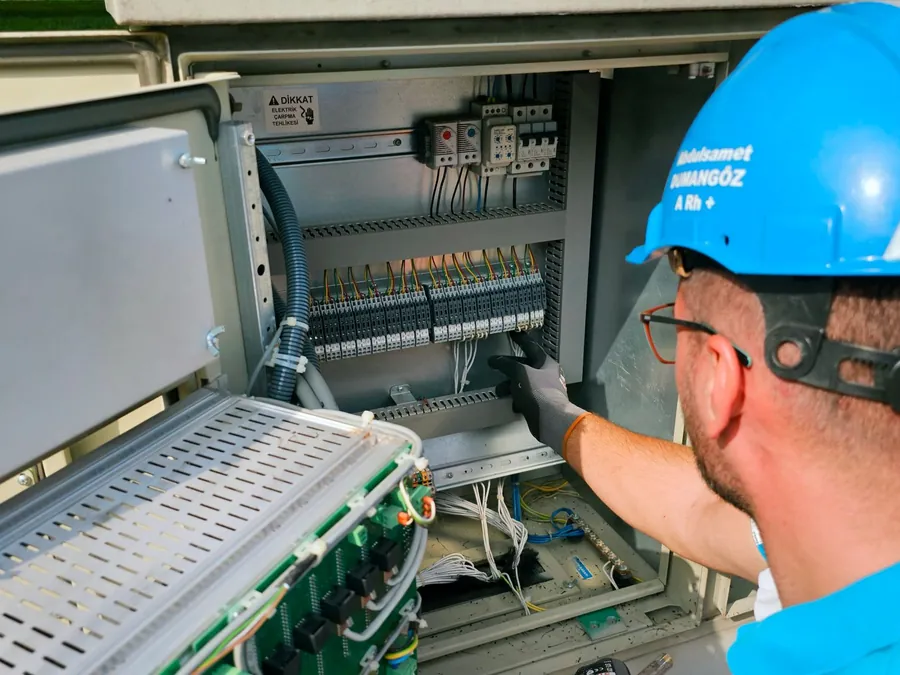
How we price maintenance
The main variables are the array size, how easy and safe the roof is to reach, and whether there's a battery to inspect too. A ground array or a carport takes less time than an array spread across a fragile shed roof that needs edge protection. First visits to inherited systems take longer because we're documenting as we go. We quote either per visit or as an annual plan with a set number of inspections, cleaning and remote monitoring, after seeing the system.
Commercial solar maintenance questions
Will you maintain a solar system that another company installed?
Yes. A lot of our maintenance work is on systems fitted by firms that have closed or stopped responding. On the first visit we identify the panels, inverters and protection, test everything and produce the documentation that should have been handed over. If the monitoring portal belongs to the old installer's account, we can often get access transferred through the inverter manufacturer, or fit our own logger.
How often should commercial solar panels be inspected?
Once a year is a sensible minimum for most commercial roof arrays, with a thermal survey on a bright day and full electrical testing. Large sites, battery systems, or arrays on roofs where insurers have raised fire concerns may justify more frequent visits. Remote monitoring between inspections catches inverter trips and string failures quickly, so planned visits can focus on testing rather than discovery.
Do panels in Manchester need cleaning, given all the rain?
Usually less often than in drier places, but rain doesn't do the whole job. Low-tilt and flat-roof arrays hold water along the bottom frame, and as it evaporates it leaves a line of dirt that shades the bottom row of cells. Arrays near busy roads, yards and the Ship Canal pick up more grime than average. We clean when the data or a visual check shows it's worth doing.
Our inverter shows a fault code. Is it worth repairing?
That depends on the fault, the age of the unit and whether parts are still available. Some codes clear after a reset or point to an isolation fault in the array rather than the inverter itself. Others mean the unit has failed. We test the strings first, so you're not replacing an inverter that was protecting itself from a cable fault. If replacement is the answer, we size the new unit for any planned battery.
What does RC62 mean for our rooftop array?
RC62 is a joint code of practice on fire safety for PV installations, published by the Fire Protection Association in 2023 with RISCAuthority, MCS and Solar Energy UK, mainly aimed at commercial rooftop systems. It covers design, installation and inspection. Insurers use it as a reference, so it's worth knowing how your array measures up. We can assess the system against it and flag anything worth discussing with your broker.
Is it safe to work on an older asbestos-cement roof?
With the right controls, yes, but it needs planning. HSE treats fibre-cement sheets as fragile, and asbestos-cement work becomes notifiable if sheets are substantially broken. For maintenance we avoid walking on the sheets, use staging or walkways and protect rooflights. If the roof is close to the end of its life, it may be cheaper to lift the array, replace the roof and refit than to keep repairing around it.
Related: Commercial solar panels · Battery storage · Ground-mounted solar
What Manchester businesses say about us
We're a new name, so you won't find a wall of reviews here yet. We'd rather show you nothing than make some up.
For a project this size, reviews were never the best evidence anyway. Ask any installer you're considering for a reference site you can visit, a year or more of generation data from a system they fitted, and the grid connection paperwork from a past job. If they can't produce those, keep looking.
Where we maintain commercial solar in Greater Manchester
Get an underperforming array checked
Send us the array size, the inverter make if you know it and a few months of generation or meter readings. We'll tell you whether the numbers look wrong before we book a visit.