
5 November 2026
What Happens To Surplus Solar Power On A Manchester Business Site?
Where surplus solar goes on a Manchester business site: self-use against export, Smart Export Guarantee rules, sizing to daytime load, batteries and private wire.
Every solar array on a Greater Manchester business roof splits its output two ways. Some of it gets used in the building as it’s made, and the rest leaves through the meter for the grid. Most of the value is in that split. Government figures put the average non-domestic electricity price at 24.51p per kWh in the second quarter of 2026, and every unit of solar you use yourself avoids paying it. Every unit you export earns whatever export deal you’ve managed to sign, if you’ve signed one at all. Using PVGIS data, a 150kWp array near Heywood makes around 121,000kWh in a year, but that’s about 574kWh a day in June and only 72kWh a day in December. This guide covers what happens to surplus solar, how business export payments work, and why getting the size right against your daytime load matters far more than chasing export income.
Where surplus solar goes on a Manchester business site
Nobody has to send the power anywhere. The inverters push it into the building’s wiring, and it feeds whatever is running at that moment: lights, compressors, chillers, chargers. Only when the site is using less than the panels are making does the extra flow back out through the incoming supply.
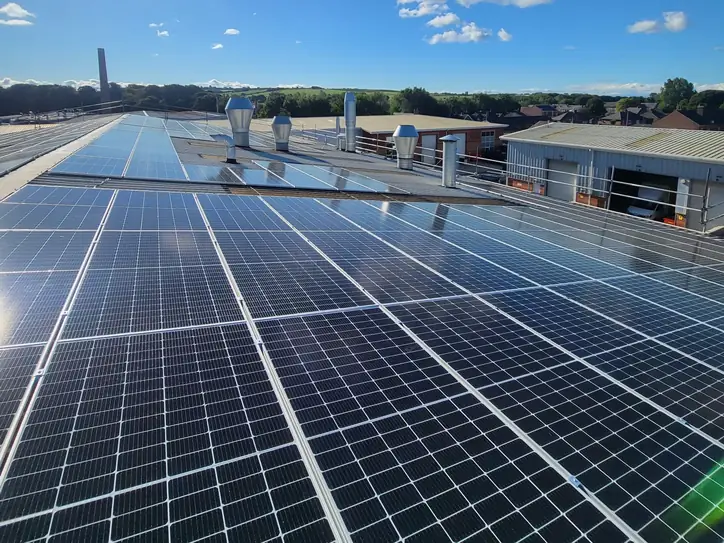
That makes surplus a question of timing, not size alone. A machine shop running two shifts can swallow a large array without a single unit spilling over. A trade counter that shuts at 1pm on Saturday sends the whole of a sunny Saturday afternoon to the grid. When we’re sizing commercial solar panels for a Manchester business, the first thing we ask for is half-hourly meter data, because that shows exactly when the building is hungry and when it isn’t.
There are three places surplus can end up. It gets exported and paid for, exported and not paid for, or it’s never made at all, because the inverters throttle back on an export-limited connection. Which one applies to you depends on your contracts and your grid connection as much as on your roof.
Self-consumption against export: why one unit beats another
A unit used on site saves your full import price, plus the levies and network charges that ride on top. A unit exported earns an export rate that’s set by whoever buys it.
The government’s Quarterly Energy Prices release for September 2026 puts the average non-domestic electricity price, including Climate Change Levy, at 24.51p per kWh for April to June 2026. That figure is an average across every size of business, so your own unit rate could sit well above or below it. Use your bill, not the national figure, when you run your sums.
Export rates for businesses aren’t published in one place, and they change. In the export quotes customers have shown us, the business rate has usually been a small fraction of what they pay to import. So a unit used in the building tends to be worth several exported ones. That’s why we’d never size an array around the export cheque.
How the Smart Export Guarantee works for business solar
The Smart Export Guarantee, or SEG, is the main way small and mid-sized generators get paid for exported power. It’s not a fixed tariff. It’s an obligation on some suppliers to offer you a deal.
Ofgem’s Smart Export Guarantee guidance for generators sets out the main points:
- It covers solar installations with a total installed capacity of up to 5MW. Anything bigger is sold under a commercial contract instead.
- Suppliers with at least 150,000 domestic customers must offer at least one SEG tariff. Smaller suppliers, including many that mostly serve businesses, can take part voluntarily.
- Each supplier picks its own rate, type and contract length, but the rate must be above zero at all times.
- Your export must be measured by a meter that can take half-hourly readings and has an export MPAN, which is a separate 13-digit number from the import MPAN on your bill.
- You can only take SEG from one supplier at a time, and it doesn’t have to be the company that sells you electricity.
Certification depends on size. For solar of 50kW or less, you’ll be asked to show the installation and the installer are certified, usually with an MCS certificate or an equivalent. Between 50kW and 5MW, the supplier still wants evidence that the installation is suitably certified, but there’s no installer certification requirement, and each supplier decides what it will accept. If you’re in the larger band, ask the supplier what paperwork it needs before your installer hands over the commissioning pack.
Beyond SEG, larger sites sometimes sell export through a negotiated agreement with a supplier or an energy buyer. Those can pay more, and they can also bind you for years. Read the termination terms as closely as the rate.
Sizing to daytime load: a worked example near Heywood
Here’s the sum that changes most people’s minds. We modelled a distribution unit near junction 19 of the M62 at Heywood using hourly PVGIS solar data, a 10° panel tilt and a simple load: 45kW from 7am to 6pm on weekdays, and an 8kW base load for the freezers, servers and security lighting the rest of the time. That’s about 177,000kWh a year. It’s an illustration, not a quote. Your own half-hourly data will look different.
| Array size | Output a year | Used on site | Exported |
|---|---|---|---|
| 80kWp | about 64,700kWh | about 51,900kWh (80%) | about 12,800kWh (20%) |
| 150kWp | about 121,300kWh | about 74,300kWh (61%) | about 47,000kWh (39%) |
Going from 80kWp to 150kWp nearly doubles the output, but only about 22,400 of the extra 56,600kWh gets used in the building. The other 60% goes out of the door. Put the 24.51p average against an export rate of 5p, which we’ve picked purely to make the sum easy to follow, and the first 80kWp earns roughly 20.6p for every unit it makes. The extra 70kWp earns about 12.7p a unit. The panels cost much the same per kW. The return on the second half doesn’t.
Weekends are a big part of this. Saturdays and Sundays carry around 28% of a year’s solar output, and a site that shuts on both throws most of that at the grid. Add the eight bank holidays in England and any Christmas shutdown, and a five-day business exports a lot more than its weekday load suggests.
None of this means smaller is always better. If export is paid fairly, the roof is big and your demand is likely to grow, a larger array can still make sense. Just know which units are paying for it.
How battery storage shifts the balance
A battery takes the midday surplus and moves it to the evening and night, when the site is still drawing power but the panels have stopped. That turns a unit you’d have exported cheaply into one that avoids your import price.

In our Heywood model, adding a 100kWh battery to the 150kWp array cut export from about 47,000kWh to about 29,000kWh a year. Roughly 17,100kWh came back out of the battery into the building’s overnight and evening load. At the same illustrative prices, that’s worth around £3,300 a year more than exporting it. Whether that pays for the battery depends on its price, its warranty and what else it can do for you, and we’ve gone through capacity charges, the 4pm to 7pm red band and backup power in whether battery storage is worth it for a Manchester business.
One catch on export payments. If the battery also charges from the grid, perhaps on a cheap overnight rate, your export meter can no longer prove that everything it records came from the panels. Ofgem’s guidance says the SEG supplier then isn’t obliged to pay on that export. It can pay on all of it, none of it, ask for extra meters, or estimate the grid-charged share. Agree how it’ll be handled before you set the battery’s charging schedule.
Selling to the unit next door: private wire and on-site supply
On a multi-let estate there’s often a neighbour who’d happily buy your Saturday surplus, or a tenant on the same landlord’s site in Trafford Park who runs seven days. Selling power to them sounds simple. Legally, it makes you an electricity supplier, so it needs to sit inside a licence exemption.

The government’s licence exemptions FAQ, revised in September 2026, explains the main routes. Most exempt supply happens on private networks and within single premises, under the on-site and resale classes. The Class A small supplier exemption is the one that allows supply across the public network. It caps you at 5MW supplied at any one time, of which no more than 2.5MW can go to domestic consumers.
A few practical points come out of that guidance:
- A Class A supplier can only supply power it generates itself. It can’t buy in electricity to top up a customer, so your neighbour still needs an ordinary supply contract for the hours your panels can’t cover.
- Over the public network you’ll need a licensed supplier to handle metering, data collection and settlement on your behalf. That service has a cost, which comes out of the margin you were hoping to share.
- Using a broker or a sleeving supplier doesn’t move the legal obligations off you. You’re still the exempt supplier.
A physical private wire, where you run your own cable to a building next door, avoids some of the network side but brings trenching, metering and wayleave questions with it. Either way, put it in writing: price, metering, liability, and what happens when one of you moves out. We’d also get a solicitor involved before any cable goes in the ground.
When the grid caps your export
Some sites never get the choice. Where the local network is short of capacity, SP Electricity North West may approve your G99 connection only with an export limit, and the inverters then hold back whatever the building can’t use. That surplus isn’t sold or stored. It’s simply never generated.
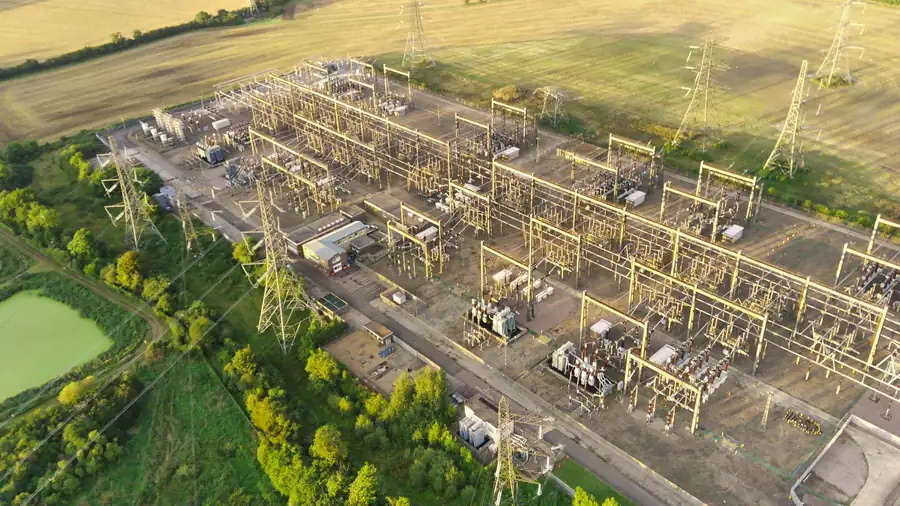
On an export-limited site, sizing to daytime load stops being sensible advice and becomes a hard rule, and a battery becomes the only way to bank the extra. We’ve explained how limits are set and what they do to timescales in our guide to the G99 grid connection in Manchester.
Before you sign for an array, get straight answers to these:
- How much of the output is modelled as used on site, month by month, and is that based on our half-hourly data?
- Is the connection likely to be export-limited, and to what level?
- Which supplier would pay for our export, at what rate, and for how long?
- Do we have, or need, a half-hourly export meter and an export MPAN?
- If a battery is proposed, will it charge from the grid, and how does that affect export payments?
- Is there a neighbour or tenant who could use our weekend surplus, and is it worth the legal work?
If an installer can’t answer the first one from your own data, the rest of their savings figure is guesswork.
Frequently asked questions
Do business electricity suppliers have to pay us for exported solar?
Only some of them. Under the Smart Export Guarantee, licensed suppliers with at least 150,000 domestic customers must offer at least one export tariff to eligible generators, and other suppliers can join in voluntarily. The rate must always be above zero, the export has to be measured by a meter that records half-hourly readings and has an export MPAN, and you can only take a SEG tariff from one supplier at a time. That supplier doesn't have to be the one you buy your electricity from.
Does the Smart Export Guarantee cover arrays bigger than 50kW?
Yes. It covers solar installations up to 5MW. For solar of 50kW or less you'll be asked to show that both the installation and the installer are certified, usually with an MCS certificate or an equivalent. Above 50kW the supplier still wants evidence that the installation is suitably certified, but there's no installer certification requirement, and each supplier decides what proof it will accept.
Will we still get export payments if our battery charges from the grid?
Not necessarily. If the export meter also records power that didn't come from the solar, such as a battery charged from the grid, the supplier isn't obliged to pay SEG on it. It can pay on all of the export, none of it, ask you to fit extra meters so the grid-charged share can be deducted, or estimate it. Suppliers handle this differently, so ask before you sign.
Can we sell our spare solar to the business next door?
It can be done, but it's a supply arrangement with rules attached. Government licence-exemption guidance says the Class A small supplier exemption lets a generator supply its own output, up to 5MW at any one time and no more than 2.5MW of that to domestic consumers. A Class A supplier can't buy in power to top up its customers, so the neighbour still needs a normal supply contract, and over the public network you'll need a licensed supplier to handle metering, data and settlement. Most firms take legal advice before agreeing one.
How much of our solar should we expect to export?
It depends on when the site is busy. In our rough model for a distribution unit near Heywood that works weekdays from 7am to 6pm, an 80kWp array exported about a fifth of its output and a 150kWp array about two fifths. Weekends alone account for around 28% of a year's solar output, so a site that shuts on Saturday and Sunday will export more than one that runs seven days.
Thinking about solar or a battery for your site?
Send us a year of half-hourly data and we'll tell you, in writing, what size of system makes sense and roughly what it would save. Manchester, Salford, Trafford, Bolton, Wigan and in between.